

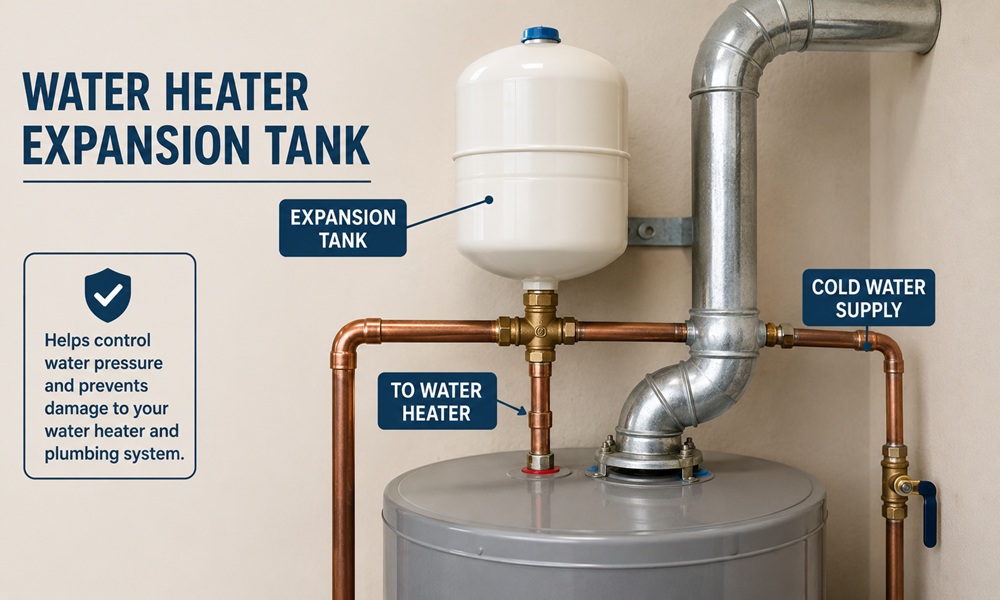
Water expands when heated. In a sealed system that expansion has nowhere to go, so pressure climbs. An expansion tank gives that extra volume a place to land, protecting the whole system. Here is what you need to know before installing, sizing, or replacing one.
What does a water heater expansion tank do?
When your heater warms a tank of water, the water’s volume increases slightly. In an open system, that extra water can push back into the city main. But most modern homes have a one-way valve on the supply, a backflow preventer, pressure-reducing valve, or check valve, that stops backflow. That makes the system “closed.”
In a closed system, the expanded water is trapped. Pressure rises with every heating cycle. An expansion tank contains a rubber diaphragm with an air cushion on one side. As pressure builds, water pushes into the tank and compresses the air, absorbing the spike. When you open a tap, the water flows back out. It is a simple, mechanical shock absorber for your plumbing.
Do I actually need an expansion tank?
You need one if you have a closed system, and most codes now require it in that case. Check for any of these on your main water line:
- A pressure-reducing valve (PRV), common where street pressure is high.
- A backflow preventer, often required by the water utility.
- A check valve on the incoming supply.
If any are present, your system is closed and thermal expansion has nowhere to go. Codes generally require expansion control on water heaters in closed systems, and many jurisdictions require the tank to be added whenever the water heater is replaced or a major repair triggers a code update. That is why a new water heater install often comes with a new expansion tank.
Tankless water heaters typically do not need one, since they heat only the water being used and relieve pressure instantly, making expansion negligible.
What happens without one?
Thermal expansion in a closed system is quietly destructive. The pressure it creates can:
- Shorten the water heater’s life and stress its connections.
- Cause the temperature and pressure (T&P) relief valve to “weep” or drip.
- Damage faucets, cause leaks, and produce noisy water hammer.
- Strain washing machine and dishwasher fill valves.
Critically, most water heater warranties do not cover failure caused by thermal expansion. Skipping the tank can void your coverage.
How do I size a water heater expansion tank?
Two inputs drive the size: your water heater capacity and your incoming supply pressure.
Rule of thumb: for a standard residential heater up to 50 gallons at supply pressure under about 60 psi, a 2-gallon expansion tank is the common choice.
| Water heater size | Typical residential tank (normal pressure) |
|---|---|
| Up to 50 gallons | 2 gallons |
| 60 to 80 gallons | Larger tank or step up per manufacturer chart |
| Higher pressure or larger heater | Use the manufacturer sizing chart or add tanks |
Higher supply pressure and larger heaters increase the volume you must absorb, so move up in tank size. Manufacturers publish sizing charts and online calculators that take your exact capacity and pressure. If your static pressure exceeds 80 psi, code generally calls for a pressure-reducing valve too. When in doubt, size up or ask a plumber, an undersized tank does not protect the system properly.
Pre-charge the air pressure. The tank’s air-side pressure should match your home’s static water pressure before installation. Check your pressure with a gauge on an outdoor faucet or laundry hookup, then set the tank’s Schrader valve to match.
Where does it get installed?
On the cold water supply line, on the inlet side of the water heater. Most codes require it within about 18 inches of the heater, though some allow up to 36 inches.
- The tank can mount in various orientations, but many manufacturers now recommend upright to extend diaphragm life.
- Support it properly. A 2-gallon tank weighs close to 20 pounds when full, so it should not hang on the pipe alone.
- Leave access to check air pressure and replace it later.
How do I know if my expansion tank has failed?
Expansion tanks are a wear part, often lasting 5 to 10 years. Signs of failure:
- The T&P valve on the heater starts dripping or discharging.
- Water hammer or banging pipes return.
- Tapping the tank: the top should sound hollow (air) and the bottom solid (water). A tank that sounds full of water throughout has a ruptured diaphragm.
- Water sprays out of the air valve when you press it (should release only air).
A failed tank no longer absorbs pressure, so replace it promptly to protect the heater.
FAQ
Is an expansion tank required by code?
In a closed system (one with a backflow preventer, PRV, or check valve), yes, in most jurisdictions, and it is often required when you replace the water heater. Rules vary locally, so confirm with your inspector.
What size expansion tank for a 40 or 50 gallon heater?
A 2-gallon tank is the standard choice for heaters up to 50 gallons at normal supply pressure. Size up for higher pressure or larger tanks using the manufacturer chart.
Do tankless water heaters need an expansion tank?
Usually not. They heat water on demand and relieve pressure instantly, so expansion is negligible. Confirm with local code.
How long does an expansion tank last?
Commonly 5 to 10 years. Check the air pre-charge periodically and replace the tank when the diaphragm fails or the T&P valve starts weeping.