

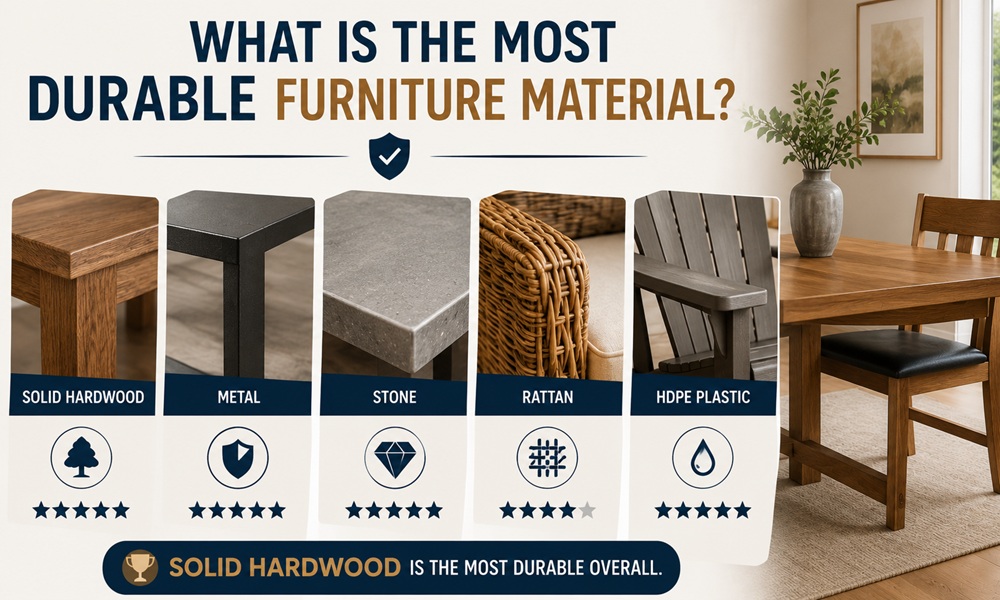
Quick answer: The most durable furniture material is solid, kiln-dried hardwood, species like oak, maple, hickory, walnut, and especially teak, which resists dents, warping, and moisture and can last decades or generations. Steel frames rival wood for strength and support the most weight. Avoid particleboard, MDF, and low-grade softwood cores, which break down fastest. The single best durability check is the frame material, not the finish you see on top.
Furniture longevity is decided by what you cannot see: the frame and joinery. A gorgeous surface over a particleboard core fails fast. A plain piece on a solid hardwood or steel frame outlasts it by decades. Here is what actually holds up, ranked.
What makes furniture durable in the first place?
Three properties determine how long a piece survives real life.
- Frame strength. Can it carry weight repeatedly without bending, cracking, or wobbling. Solid hardwood and steel win here.
- Surface hardness. How well it resists dents and scratches, measured for wood by the Janka scale.
- Moisture and heat resistance. Wood swells and warps when wet, metal rusts without coating, and heat weakens glue joints. Kiln-dried wood and coated metal resist these best.
Always check the frame first. A surface finish tells you nothing about how long the piece will last.
Ranked: the most durable furniture materials
1. Solid hardwood (the benchmark)
Kiln-dried hardwood is the gold standard for furniture that lasts. Kiln drying removes moisture before milling, so the wood resists warping and cracking through seasonal humidity swings. Species matter enormously, and the Janka hardness scale (the force needed to dent the wood) ranks them.
| Wood | Janka (lbf) | Notes |
|---|---|---|
| Teak | ~3,680 | Exceptional stability and moisture resistance, 50+ years outdoors, 200+ indoors |
| Hickory | ~1,820 | Hardest common domestic furniture wood |
| Hard maple | ~1,450 | Dense and strong, prone to more seasonal movement |
| White oak | ~1,360 | Excellent all-rounder, better moisture resistance than red oak |
| Red oak | ~1,290 | Classic, durable, widely available |
| Walnut | ~1,010 | Beautiful, strong, heirloom-grade |
| Pine (softwood) | ~380 to 870 | Dents and scratches within months of family use |
Hardwoods like oak, maple, hickory, walnut, and ash outperform pine, poplar, and rubberwood in a structural role. A kiln-dried white oak dining table absorbs daily use and humidity without losing integrity, where the same table in undried softwood shows movement within a few years.
Best for: dining tables, dressers, bed frames, anything you want to keep for decades. Hardwoods can be sanded and refinished repeatedly, so scratches are renewable, not fatal.
2. Metal (steel and iron frames)
Steel and iron frames handle the most weight of any material and will not dent from everyday impacts. Powder-coated or galvanized metal resists rust and needs little maintenance.
The trade-offs: uncoated metal rusts, and it offers no give, so comfort depends on cushioning. For bed frames, table bases, and outdoor pieces, quality coated metal is extremely long-lived.
3. Full-grain leather (upholstery)
For upholstered surfaces, full-grain leather is among the most durable coverings. It ages into a patina rather than wearing out and resists tearing far better than most fabrics.
4. High-grade engineered options (with caveats)
Furniture-grade plywood is stable and stronger than it gets credit for, and it resists the warping that solid panels can suffer. It is a legitimate choice for hidden structural parts. The problem is the low end: particleboard, MDF, HDF, and low-grade laminates lose strength as moisture, swelling, and adhesive failure set in.
What furniture materials should you avoid?
- Particleboard and low-grade MDF cores. They sag, swell, and crumble, especially near moisture. Common in flat-pack budget furniture.
- Low-grade softwood frames. They flex and break under regular pressure.
- “Solid wood” without a species named. The label “solid wood” can legally include softwoods or engineered composites. Ask exactly which wood.
A caution echoed across r/woodworking and furniture communities: an old, solid hardwood piece with tight joints often outlasts a brand-new budget item built from engineered wood. Secondhand solid wood can be the smarter buy.
How do I check quality before buying?
Use these three questions, straight from what furniture pros recommend.
- What is the frame material? The right answers are kiln-dried hardwood, steel, or furniture-grade plywood. If they just say “solid wood,” ask which species.
- What is the upholstery rub count? This measures fabric durability in double rubs. 15,000 is minimum for light use, 30,000+ for daily family use, 50,000+ for heavy or commercial use.
- How are the joints made? Look for joinery like dovetails, mortise-and-tenon, or corner blocks, not just staples and glue. Solid joinery is what keeps a frame tight for decades.
How long should durable furniture last?
- Solid hardwood: 30 to 100+ years, often passed down generations.
- Softwood (pine, cedar): 20 to 40 years with normal use.
- Quality coated metal: decades, limited mainly by rust if the coating fails.
- Budget engineered furniture: often a handful of years before sagging or joint failure.
Keeping indoor humidity between roughly 35 and 55 percent extends the life of nearly every material by limiting wood movement and metal corrosion.
FAQ
What is the single most durable wood for furniture?
Teak, thanks to its very high Janka hardness, dimensional stability, and natural moisture resistance. Among common domestic woods, hickory and white oak lead.
Is metal or wood furniture more durable?
Both are excellent. Steel handles the most weight and will not dent, while solid hardwood resists everyday wear, can be refinished, and lasts generations. Choose by use: metal for structural strength, hardwood for classic longevity.
Is “solid wood” always durable?
Not necessarily. The term can include softwoods or engineered composites. Ask for the specific species and confirm it is kiln-dried.
What is the least durable furniture material?
Particleboard and low-grade MDF, which swell, sag, and crumble with moisture and weight, followed by low-grade softwood frames.