

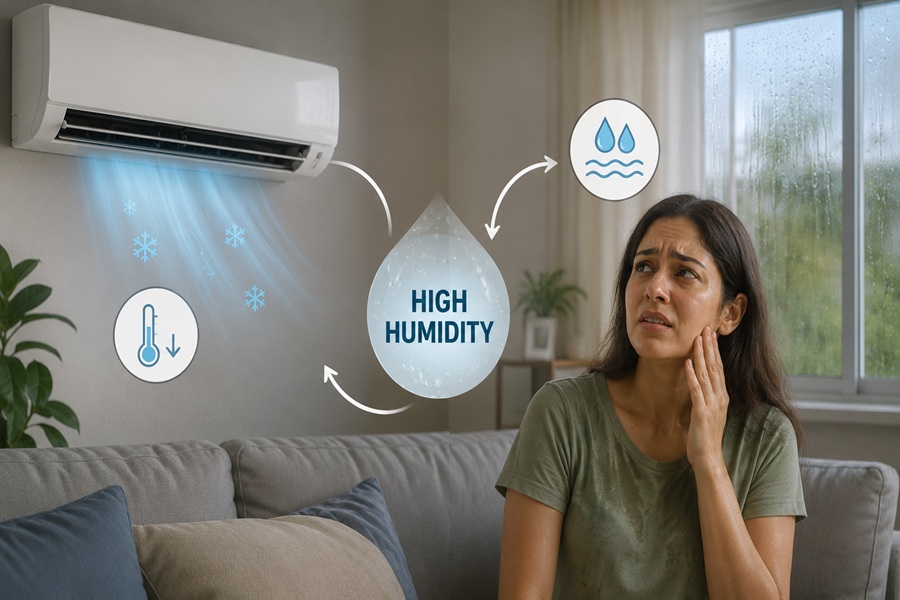
The thermostat says the temperature is fine. The air feels cool. Yet the house feels damp, sticky, and clammy anyway.
You are not imagining it, and lowering the thermostat further will not fix it. Your air conditioner is failing at its second job.
Because an AC has two jobs, not one. It cools the air, and it pulls moisture out of it. When the second job breaks down, you get a cool house that still feels humid.
Quick answer: A house feels humid with the AC running when the system cools the air without removing enough moisture. The usual causes are an oversized unit that shuts off too fast, short cycling, a dirty filter, low refrigerant, a frozen coil, leaky ducts, or a fan set to run constantly. Comfortable indoor humidity sits around 30 to 50 percent. If yours is higher, the fixes below usually solve it.
How is your air conditioner supposed to remove humidity?
Here is the part most people never learned.
Warm indoor air is pulled across a cold evaporator coil. As the air touches that cold surface, moisture condenses into water, drips into a pan, and drains away outside. The air that returns to your rooms is both cooler and drier.
That moisture removal takes time. The system has to run long enough for a lot of air to pass slowly over the coil.
So anything that stops the AC from running long enough, or stops air and refrigerant from doing their job, leaves the moisture behind.
What are the signs your AC is not removing humidity?
You will notice some of these even when the temperature reads normal:
- A cool but clammy, sticky feeling in the air.
- Condensation or fog on windows and vents.
- Musty odors.
- Damp-feeling bedding, towels, or upholstery.
- A thermostat that says the room is fine while you feel uncomfortable.
What causes a humid house when the AC is on?
| Cause | What is happening | The fix |
|---|---|---|
| Oversized AC | Cools too fast, shuts off before dehumidifying | Right-size the system, add a dehumidifier |
| Short cycling | Turns on and off too often, never finishes the job | Have a technician diagnose the cause |
| Dirty air filter | Restricts airflow, can freeze the coil | Change the filter |
| Low refrigerant | Cools weakly, removes little moisture | Professional leak repair and recharge |
| Frozen evaporator coil | Coil iced over, cannot absorb moisture | Fix airflow or refrigerant, let it thaw |
| Leaky ductwork | Pulls in humid attic or crawlspace air | Seal the ducts |
| Clogged condensate drain | Water cannot escape, backs up | Clear the drain line |
| Fan set to “on” | Blows collected moisture back into rooms | Switch the fan to “auto” |
Why a bigger AC makes humidity worse, not better
This one surprises almost everyone, so it is worth slowing down.
You might assume a more powerful air conditioner would keep the house drier. The opposite is often true.
An oversized unit cools the rooms so quickly that it hits the target temperature and shuts off before it has run long enough to wring the moisture out of the air. Think of pulling bread out of the oven early. The outside looks done, but the inside never finished.
Result: a cold house that still feels damp. Bigger is not better for humidity. Correctly sized is.
The fan setting trap most guides miss
Here is a nuance that trips people up, especially anyone who was told to run the fan on “on” to even out room temperatures.
When your fan is set to “on,” it runs constantly, even after the cooling cycle stops. The problem is that when the cooling stops, the coil is still wet with the moisture it just collected. The running fan blows air across that wet coil and pushes the moisture right back into your rooms before it can drain away.
So there is a real tradeoff:
- Fan on “on” helps circulate air and even out hot and cold rooms, but it can raise humidity.
- Fan on “auto” runs only during cooling, so the moisture drains instead of re-evaporating, which keeps the house drier.
If humidity is your main complaint, set the fan to “auto.” If you were running it on “on” for even temperatures, that may be exactly why the house feels muggy.
What can you do yourself today?
Before calling anyone, run through the homeowner checks:
- Measure it. Buy an inexpensive hygrometer and confirm the humidity is actually high (above 50 to 55 percent). Now you know what you are fighting.
- Set the fan to “auto.” Free, instant, and often noticeable.
- Change the filter. A clogged filter restricts airflow and can freeze the coil.
- Clear the vents. Make sure furniture and rugs are not blocking supply or return vents.
- Find indoor moisture sources. Run bathroom and kitchen exhaust fans, cover cooking pots, and check for damp basements or crawlspaces adding moisture faster than the AC can remove it.
- Seal obvious leaks. Weatherstrip doors and windows so humid outdoor air is not pouring in.
When should you call a professional?
If the fan setting, filter, vents, and moisture sources do not explain it, the issue is inside the system. Call a technician for:
- Suspected low refrigerant or a frozen coil.
- Short cycling.
- Leaky ductwork.
- A system that seems oversized for the home.
The strongest long-term fix in a humid climate is often a whole-home dehumidifier working alongside a correctly sized AC. It controls moisture independently of temperature, so you get a house that is both cool and dry.
Frequently asked questions
What should indoor humidity be in summer?
Around 30 to 50 percent is the comfortable target. Above that, the air feels sticky and can encourage mold and dust mites. A cheap hygrometer tells you where you stand.
Can a dirty air filter make my house humid?
Yes. A clogged filter restricts airflow, which reduces the system’s ability to remove moisture and can even freeze the coil. Changing it is a quick, safe first step.
Will lowering the thermostat reduce humidity?
Not reliably. It makes the house colder, but if the unit is oversized, short cycling, or has airflow problems, it still will not run long enough to dehumidify. You end up cold and damp.
Should my AC fan be on “auto” or “on”?
For lower humidity, choose “auto.” Running the fan on “on” continuously can blow moisture off the wet coil back into your rooms. Use “on” only when even room temperatures matter more than dryness.
Do I need a dehumidifier if I have air conditioning?
In very humid climates, often yes. A whole-home dehumidifier removes moisture on its own, so your comfort no longer depends on the AC running long enough to do it.