

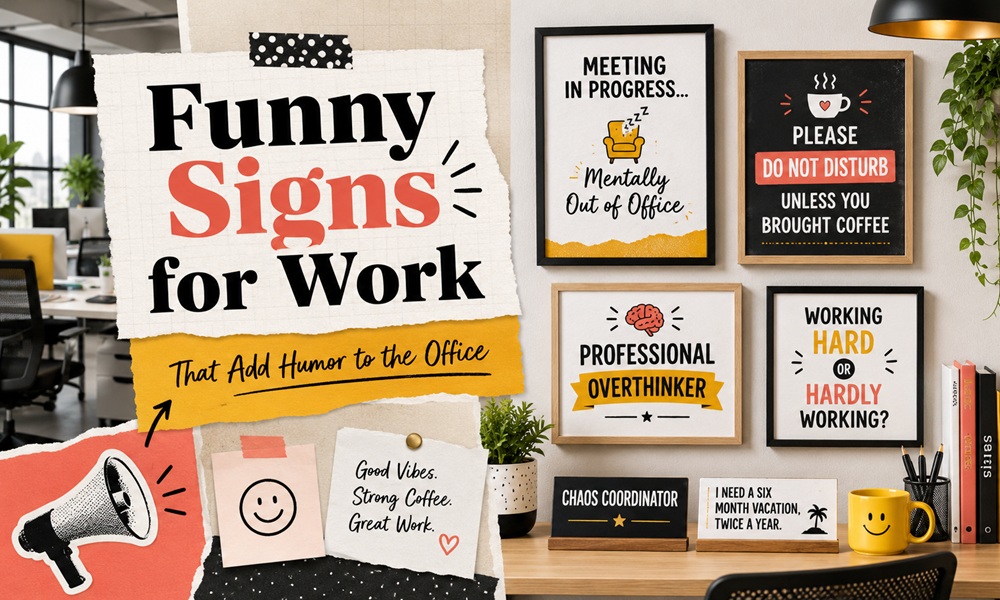
A good sign is the cheapest way to give a workspace personality. One sharp line, well designed, can carry a whole desk. A bad one just adds clutter. The difference is all in the writing and the design.
This guide breaks down the sign types, the tones that work, and how to pick or write one that actually lands.
What makes a funny work sign good?
Three things. Clean design, bold print, and a joke that survives a second reading.
The last part matters most. A quick laugh that dies on re-reading is a novelty. A line that still lands the third time you glance at it becomes part of the room. And never make it too clever to understand, if people have to decode the joke, it defeats the point. Keep it simple, sharp, and impossible to ignore.
What types of funny work signs are there?
Signs come in a few formats, each with its own strengths.
| Sign type | Format | Best for |
|---|---|---|
| Desk sign / plaque | Small acrylic or wood, sits on the desk | Personal humor, a daily talking point |
| Warning / caution sign | Bright yellow, warning-sign styling | High visibility, deadpan office jokes |
| Door sign | Hangs or mounts on a door | Meeting rooms, home office doors |
| Cubicle sign | Small, mounts to a panel | Tight shared spaces |
| Flip / mood sign | Multiple pages you flip through | Showing your mood without words |
Acrylic signs, often around 4×4 or 4×6 inches, look crisp and modern. Wood signs with vinyl lettering give a warmer, more handmade feel. Both work; the choice is about the vibe you want.
Which tone should your sign take?
Tone is where a sign wins or fails. A few reliable directions:
- Profession-specific. A joke about your exact job reads sharper than a generic one.
- Deadpan. Dry, understated lines age better than loud ones.
- Mildly threatening (playfully). A meeting-room warning or a “do not borrow my stuff” desk sign works because it is relatable.
- Relatable-mood. A flip sign that shows how you feel today, no words needed, gets a laugh because everyone gets it.
- Countdown humor. Friday-focused lines are perennial because the whole office is thinking it.
The safest bet is a sign that feels a bit smarter than the average novelty gift.
Where should you put a funny sign?
Placement changes the payoff.
- On the desk: at eye level, one hero sign, not a row of them.
- On the wall or cubicle panel: as an anchor when the rest of your setup is clean.
- On a door: a meeting-room or home-office door sign sets the mood before anyone enters.
- Behind you on video calls: legible and deadpan, so it rewards a second glance rather than shouting over the meeting.
The one-sign rule
Get one excellent sign, not five. A single sharply worded plaque can carry the whole room if the line is good and the design is better. This is doubly true in cubicles and small offices, where space is tight and every object has to earn its keep. Five signs compete and cancel out. One becomes the room’s punchline.
Are funny signs good gifts?
They are one of the easiest crowd-pleasers. Funny signs suit coworker gifts, Secret Santa, white elephant swaps, Boss’s Day, birthdays, and desk-warming for a new hire. A warning-style sign in bright yellow is a popular pick because it is instantly noticeable and reads as a joke from across the room.
The rule for gifting is the same as for buying: pick one that survives a second reading, and match it to the person, not just the occasion.
How do you write your own office sign?
Off-the-shelf signs are easy, but a custom line is what makes people actually stop. A quick method most sign guides skip:
- Start from a real, specific truth about your work. The recurring annoyance, the running team joke, the thing everyone thinks but no one says.
- Cut it to one line. If it needs two sentences to land, it is not ready.
- Make it deadpan, not loud. Understatement is funnier than exclamation marks.
- Read it three times. If it still works on the third read, it is a keeper.
- Keep the design clean. Bold, legible type. Let the words do the work.
A specific, dry, one-line sign about your actual job will always outlast a mass-market gag. That specificity is the whole trick, and it is why the best office signs feel like inside jokes rather than novelty-aisle filler.
Common questions about funny work signs
Are funny signs unprofessional?
Not if they are tasteful and workplace-safe. Clean design and a dry, inclusive joke read as personality. Skip anything that punches down or could land wrong with a client.
What material lasts best?
Acrylic is durable, modern, and easy to wipe. Wood with vinyl lettering is warmer and more decorative. Both hold up well on a desk.
How many signs are too many?
More than one or two focal signs starts to read as clutter. Pick your best line and let it stand alone.
The takeaway
A funny work sign is a tiny investment with a big personality payoff, if you choose well. Pick one sharp, well-designed sign, match the tone to your job, and place it where people naturally look. Better yet, write your own one-liner from a real truth about your work. One great sign beats a shelf of them, and it will keep earning smiles long after the gimmicky ones go quiet.