

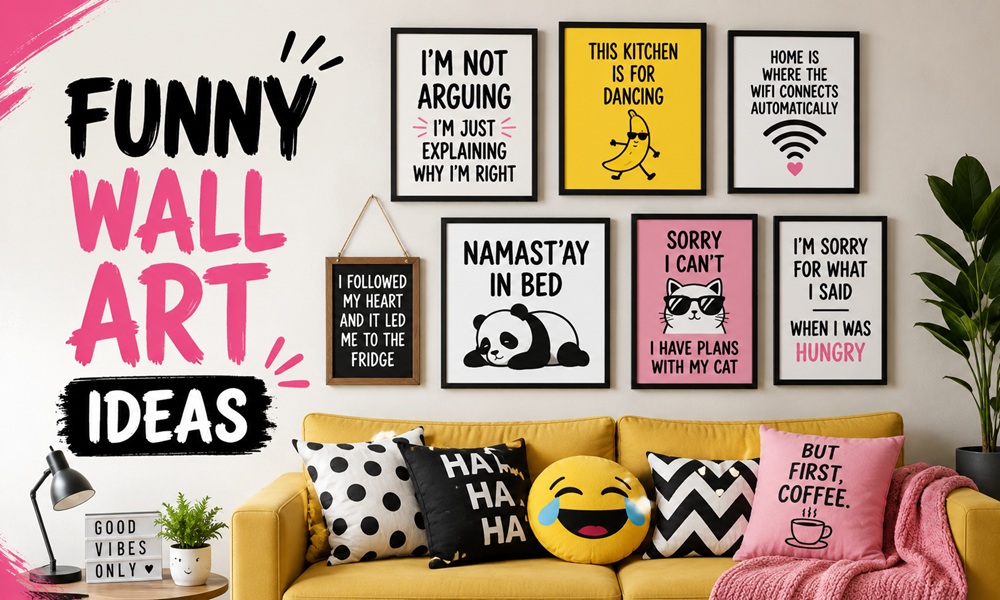
Funny wall art has a shelf life problem.
A joke you see once is funny. A joke you see four thousand times, above your sofa, for six years, is furniture. The difference between wall art that stays funny and wall art you eventually take down at 11pm out of quiet resentment comes down to two things: what kind of joke it is, and where you put it.
This guide handles both. It starts with a taxonomy of humour — because not all funny art works the same way — and then maps each type to the room where it survives.
Why Put Funny Art on Your Walls at All?
Three arguments hold up.
It signals personality faster than anything else in a room. Bold typography, colourful graphics and clever commentary let expressive decor double as a conversation starter.
It breaks the ice. A quirky piece in the living room is a great way to get guests talking.
It changes how a room feels. Surrounding yourself with humour can foster a positive mindset, uplifting the mood of everyone who enters.
And practically: a large funny print becomes an instant conversation piece and room anchor. Smaller pieces grouped together build a gallery wall with maximum visual variety.
The Six Types of Funny Wall Art
Understanding the type tells you how long the joke will last.
Type 1 — The Visual Pun
An image that resolves into a joke without words. A pigeon in a business suit. A lobster reading a newspaper.
- Decay rate: Very slow. The joke re-lands because it’s absorbed visually, not read.
- Best rooms: Living room, hallway, home office.
- Risk: Low.
Type 2 — The One-Liner (Typography)
Text-only. The joke is the sentence.
Sarcastic sayings and comical quotes appeal to a wide range of tastes and moods.
- Decay rate: Fast. You read it once. Then you’ve read it.
- Best rooms: Bathroom, hallway, entryway — places you pass through.
- Risk: High. This is where cringe lives.
Type 3 — The Absurd Animal
Funny animal wall art blends humour and charm — the smirking whimsy of a cat print, the tail-wagging comedy of a dog print.
- Decay rate: Slow.
- Best rooms: Anywhere. Genuinely.
- Risk: Low, unless it’s twee.
Type 4 — The High-Low Subversion
Classical form, ridiculous content. A Renaissance oil painting, but the subject is holding a smartphone. A vintage botanical print, but of a houseplant you’ve killed.
Pop culture parodies and classic cartoon gags sit in this territory.
- Decay rate: Very slow. The tension between form and content is the joke, and tension doesn’t wear out.
- Best rooms: Living room, dining room, hallway.
- Risk: Low. This is the most sophisticated category.
Type 5 — The Personal Joke
An inside reference. A framed screenshot. A quote only three people understand.
Pieces that resonate with inside jokes or shared experiences turn into daily reminders of fun times.
- Decay rate: Zero, if the relationship lasts.
- Best rooms: Bedroom, home office, hallway.
- Risk: Zero for you. High for guests, who won’t get it.
Type 6 — The Confessional / Self-Deprecating
The genre that has taken over Etsy and Pinterest. Prints like “At Least All the Trauma Made Me Hilarious” and “Cool People Live Here” characterise the category.
- Decay rate: Extremely fast, and it decays into something worse than boring — it decays into embarrassing.
- Best rooms: A dorm. A first apartment. Temporarily.
- Risk: Highest of all six categories.
The Decay Table
| Type | Reads in | Stays funny for | Guest reaction |
|---|---|---|---|
| Visual pun | 3 seconds | Years | Smiles |
| One-liner | 1 second | Weeks | Reads it aloud |
| Absurd animal | 2 seconds | Years | Points at it |
| High-low subversion | 5 seconds | Indefinitely | Asks about it |
| Personal joke | Never (for them) | Forever (for you) | Confused |
| Confessional | 1 second | Days | Polite nod |
The operating principle: the longer a piece takes to read, the longer it stays funny. Instant jokes die instantly.
The Room-by-Room Map
The Living Room
The living room is the hardest place to put funny art, because it’s the room you sit in longest.
What works:
- One large piece, high-low or visual pun, treated as real art
- A gallery wall where one or two pieces are funny and the rest are not
- Something with genuine craft — the humour should be the content, not the excuse
What fails:
- Typographic one-liners above the sofa
- More than two jokes in one room
- Anything that explains itself
Look for unique pieces that can become focal points — pieces that catch the eye. Rotate funny living room art with the seasons or for special occasions to keep the humour fresh and timely.
That rotation advice is the honest solution. A funny piece works best when it isn’t permanent.
The 1-in-5 rule: in a gallery wall of five pieces, one should be funny. Five funny pieces is not five times as funny. It’s a birthday card display.
Scale: A large funny print becomes an instant room anchor. Go bigger than feels comfortable. A small joke on a big wall reads as apologetic.
The Bedroom
Different rules entirely. Nobody sees this room but you.
What works:
- Personal jokes and inside references
- Couples’ humour — pieces reflecting your relationship’s unique dynamic, whether quirky, sarcastic, or sweetly humorous
- Quiet, warm humour rather than loud humour
- 18×24 is the size most commonly recommended for a couples’ bedroom piece
What fails:
- Anything that reads as an instruction (motivational text)
- High-contrast, high-saturation prints. You’re trying to sleep.
- Sarcasm. It’s the last thing you see at night and the first thing in the morning.
Design note: the bedroom is the room where funny art should whisper. Ensure the art brings a smile to both faces, because shared laughter is the heart of a happy home — but a smile, not a laugh.
The Hallway and Entryway
The natural home of funny wall art. You pass through in four seconds.
Why hallways work:
- Short dwell time means jokes don’t decay
- Nobody sits there, so a one-liner never overstays
- Hallways are usually dead visual space anyway
- It’s the first impression of your home
What works:
- Typographic one-liners (finally, their proper habitat)
- A dense grid of small prints — the joke is the volume
- Vintage signage, fake museum plaques, absurd directional signs
- Anything that rewards a second glance
The stairwell gallery: the single best location for funny art in any home. It has vertical space, low dwell time, and a natural viewing angle that makes people slow down.
The Home Office
Funny wall art for the office can spark creativity, foster a relaxed atmosphere, and potentially enhance productivity.
What works:
- Mock-official signage — the “Department of Crazy Ideas” genre
- Anything that appears behind you on video calls
- Deadpan over enthusiastic
The video call consideration nobody mentions: whatever hangs behind your desk is read by every colleague, client and interviewer you speak to for the next three years. Choose a joke you’d be comfortable explaining in a job interview. Because you will.
The Bathroom
The most popular funny bathroom prints feature humorous quotes, cheeky sayings and playful images that add whimsy.
Bathrooms tolerate the broadest humour of any room in the house. The dwell time is short, the audience is captive, and expectations are low.
Practical constraint: humidity. Use a print you can replace cheaply, or frame with a proper seal and avoid the shower wall.
The Kitchen
Essential funny kitchen wall art includes whimsical chef illustrations, pun-filled food quotes and culinary cartoons.
Food puns are the dominant genre and the shelf life is short. Covered in depth in a companion guide on kitchen signs.
The Hanging Specifications
Funny art fails more often from bad hanging than from bad jokes.
Height
Hang art with its centre 57 to 62 inches from the floor — the centre of the artwork, not the top or bottom of the frame. Museums and galleries use this rule of thumb.
Adjust by room:
| Room | Centre height | Why |
|---|---|---|
| Hallway, entryway | Higher end of range | You’re standing and moving |
| Living room, bedroom | Lower end of range | People are seated or reclined; lower eye level |
| Dining room | 54–57″ | Read from a seated position |
| Bathroom | Lower to mid-range | Users may be sitting, standing or in a bath |
| Kitchen | Higher end | Standing |
Above Furniture
Hang art about 4 to 8 inches above the top of a piece of furniture. Above a sofa or bed, keep the bottom of the frame roughly 6 to 12 inches above the furniture.
The bottom edges of your work should rest between 6 and 12 inches above furnishings and architectural features like chair rails.
Scale
Art (or a grouping) should take up at least one-half to two-thirds the width of the furniture beneath it.
When in doubt, go oversized. It will look much better than a small piece on a large wall.
Gallery Walls
Treat a grouping of multiple frames as one big piece. The same 57-inch rule applies to the vertical centre of the whole arrangement.
| Spacing | Effect |
|---|---|
| 1.5″ | Tight, editorial, professional-gallery feel |
| 2–3″ | Standard, cohesive |
| 3–4″ | Relaxed, eclectic; each piece gets breathing room |
| 5″+ | Disjointed — the grouping stops reading as one piece |
Frame gaps of no more than 1.5 to 2.5 inches create a stunning, museum-like effect — even though it initially seems too close.
The Planning Method
Lay your frames out on the floor first. Arrange and adjust until it feels balanced. Use painter’s tape or paper templates on the wall to map the layout before committing to nails.
Before hanging, have someone hold the piece up and photograph it. Look at the photo with fresh eyes. A camera flattens the wall and shows you the composition the way a guest sees it.
Framing and Mounts
Choose a frame 2 to 4 inches larger than the print on each side — a 16×20 inch print typically looks best in an 18×24 inch frame.
For funny art specifically, framing is a comedic device. A cheap joke in an expensive frame is funnier than a cheap joke in a cheap frame. The formality of the presentation is part of the gag.
How to Be Funny Without Being Cringe
The failure modes are consistent and predictable.
Rule 1 — Never Explain the Joke
If the print contains both the joke and the punchline spelled out, it will die within a week. The best funny art asks the viewer to complete it.
Rule 2 — One Joke Per Room
Two funny pieces in a living room is a wink. Five is a personality.
Rule 3 — Humour That Punches Sideways
Self-aware beats self-pitying. Observational beats sarcastic. Absurd beats mean. Everyday absurdities and timeless one-liners outlast pointed jokes about specific people or trends.
Rule 4 — Avoid Anything Trending
The confessional-typography genre is a trend. So was the “Live Laugh Love” genre before it, and so was the swear-word-in-elegant-script genre before that. Every one of them looked witty for eighteen months and dated for a decade.
Rule 5 — Test the Six-Month Question
Ask: will I still find this funny after seeing it eight hundred times?
Visual puns pass. Confessional typography does not.
Rule 6 — Make It Look Deliberate
Available in unframed prints, framed wall art and ready-to-hang canvas styles — the format is your choice, but the room should look designed, not accumulated. Consistent frames make disparate jokes cohere.
Rule 7 — Buy the Craft, Not the Caption
The visual thread in the best offbeat art is creative confidence: saturated colour, surprising compositions and illustrative styles that prioritise personality over polish. The joke should be the reason you bought it, not the only thing it has.
Where to Find It
On Amazon you’ll find an extensive range of funny wall art, from bathroom prints to office sayings. Start by filtering for top-rated items and customer reviews.
On Etsy the game is unique and handmade work, including personalised pieces. Use specific search terms like “funny bathroom wall art prints” or “funny kitchen wall art” to narrow the hunt.
| Source | Best for | Watch out for |
|---|---|---|
| Etsy | Original illustration, personalisation | Print quality varies wildly |
| Independent artists / print shops | Craft, limited editions | Cost |
| Amazon | Volume, speed, low cost | Generic typography, thin paper |
| Vintage markets / eBay | High-low subversion, old signage | Condition |
| Your own printer | Personal jokes, screenshots | It will look like it |
The category to search that most people miss: vintage advertising, old public-information posters, and antique instructional diagrams. They are unintentionally hilarious, beautifully made, and nobody else has one.
What Do Real Buyers and Designers Say?
Recurring themes from Reddit’s r/InteriorDesign, r/malelivingspace, r/femalelivingspace and r/CasualConversation, plus Quora decorating threads and Medium essays on personal style:
- “Cringe” is the most-used word in the category. It’s almost always applied to typographic prints, almost never to illustration or visual puns.
- The consensus divider is text. Community feedback consistently reads text-based humour as dated and image-based humour as timeless.
- People underestimate rotation. The most-endorsed strategy in decorating threads is buying an inexpensive frame and swapping the print seasonally.
- Framing rescues almost anything. A repeated observation: the same print looks cheap in a thin black frame and intentional in a wide oak one with a mount.
- Guests never mention the funny piece you expect. Owners consistently report that the print they thought was hilarious gets ignored, and the one they added as filler gets the laugh.
- Regret clusters in the living room. Nobody regrets a funny hallway. Plenty regret a funny sofa wall.
Frequently Asked Questions
Is funny wall art tacky? Only when the joke does all the work. Funny art with genuine craft, hung properly, at the right scale, reads as confident. Funny art printed on thin paper in a cheap frame reads as tacky regardless of the joke.
Where should funny wall art go? Hallways, entryways, stairwells, bathrooms and home offices — spaces with short dwell time. In living rooms and bedrooms, limit it to one piece and choose humour that rewards a second look.
How big should a funny print be? For a feature piece above a sofa or bed, at least half to two-thirds the width of the furniture. For a gallery wall, mix sizes but keep 2 to 3 inches between frames.
How high do I hang it? Centre it at about 57 inches from the floor — 57 to 62 inches is the working range, biased lower in seated rooms and higher in hallways.
What kind of funny art doesn’t go out of style? Visual puns, absurd animals, and high-low subversion — anything where the humour is carried by the image. Vintage designs and contemporary humour both work, with nostalgic or modern twists. Typographic one-liners date fastest.
Can funny art work in a minimalist or serious room? Yes, and it’s the best possible context. A single well-crafted funny piece in an otherwise restrained room reads as wit. The same piece in a maximalist room disappears.
Should I frame funny prints? Yes, and slightly better than the print deserves. A mount 2 to 4 inches larger than the print on each side gives even a cheap joke gravitas — and gravitas is what makes it land.
How many funny pieces is too many? One per room as a rule; two if the room is large; one in five within a gallery wall.